

Summary: How to make a frugal math manipulatives kit and teach your kids early math concepts. #homeschoolpreschool #homeschoolkindergarten #early math
When you little, everything is math!
When you little, everything is math!
Toys can be counted, towels sorted and put into sets. Cookie making became a lesson in adding and subtracting, and beads got sorted into patterns as well, as making necklaces....
Also, buttons, shells, rocks, sorted by shape, color, size, what have you. Even laundry could be sorted into sets. All of this is good early math learning!
Also, buttons, shells, rocks, sorted by shape, color, size, what have you. Even laundry could be sorted into sets. All of this is good early math learning!
Our little ones learn best through play. Basic math concepts, such as counting, sorting, bigger/smaller, same/different, adding, subtracting, etc can all be learned through play with manipulatives.
Making a Manipulatives Kit
Making a kit can be frugal and simple. We just collected small items from around the house, or from our beach collections of rocks, etc.
Manipulatives can really be any small object that you have around your house.
Buttons, shells, rocks, etc, can be sorted by shape, color, or size, and grouped into sets. This teaches early math concepts, as they are play!
Even laundry could be sorted into sets, or by size, small, medium and large, such as with towels.
Even laundry could be sorted into sets, or by size, small, medium and large, such as with towels.
We put our collected manipulatives into a shoe box, decorated it for fun, and got it out only for math play time.
That made these little toys and objects special to her.
Some of the things that we included were:
1. Rocks collected from the beach
2. Legos, or other small toys, to sort into sets, by color, size, or shape.
3. Our collection of old buttons
4. Pine cones
Stir the Wonder has a great post on Free and Affordable Math Manipulatives, full of more ideas for your kit.
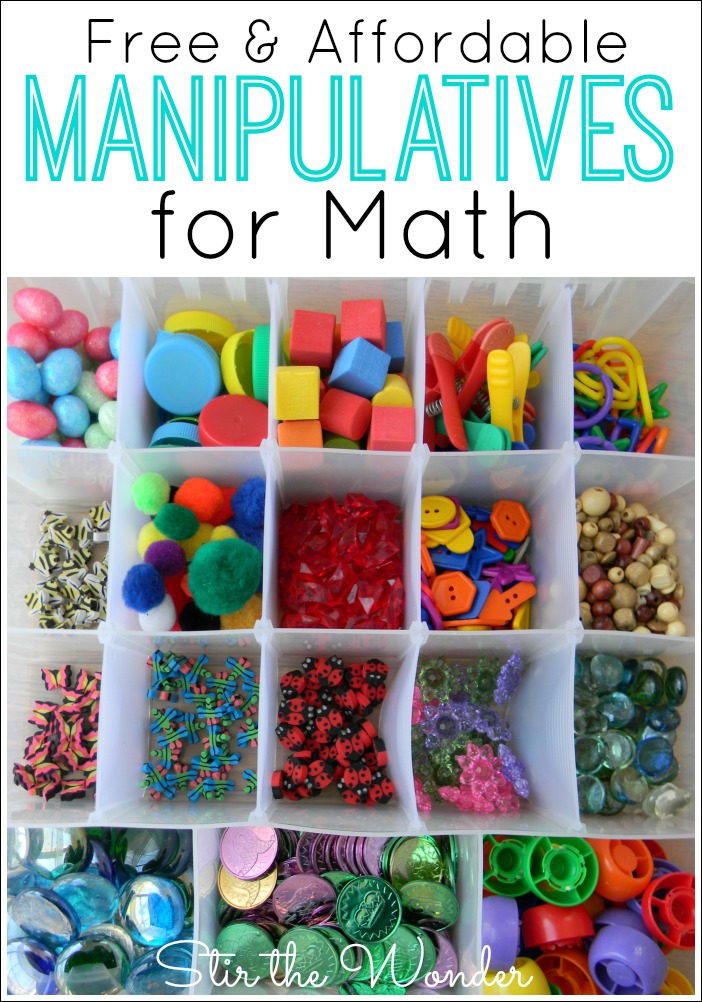
Early Math Concepts

Get out your small toys and manipulatives and let your child explore with them. While they are playing they can learn these math concepts:
1. Number Concepts:
1. Number Concepts:
Using small objects. Ask your child: How many is four? How many is six?
What if you take one away? Add two?
Ask lots of questions for number concepts to develop. Later, your child can practice this in Numbers and Patterns-K.
2. Sets:
Math is all about sets. Children making their own sets will provide true learning! They can enjoy sorting their toys into sets.
Sorting buttons by shape, then by size, etc. There are sorting activities everywhere!
My daughter enjoyed sorting laundry into sets by grouping the like sized towels/washcloths, etc.
Buttons can be sorted by size, color, or shape into sets, etc.
As your young child gets better, add in a fourth part (e.g., one more color, blue/red/yellow/purple, repeat, etc.) Coloring patterns can be fun too. There are some patterns to color in Numbers and Patterns –K.
3. Addition and Subtraction:
Cookies are the best for this! Or give your child a cookie sheet to work on with a limited number of toys. Ask your child to add the trucks to the cars or other simple problems.
4. Mathematical Patterns:
As you know, math is made up of patterns. Crayons can be used to sort into patterns, such a finding all the orange and blue crayons and lining them up for a two part pattern (e.g., orange/blue, orange/blue,etc.) Making a bead necklace is fun too. Use a two part pattern, or a three part pattern.
As your young child gets better, add in a fourth part (e.g., one more color, blue/red/yellow/purple, repeat, etc.) Coloring patterns can be fun too. There are some patterns to color in Numbers and Patterns –K.
5. Equivalents:
Making equivalents is fun!
Rods can be used for this but you can make your own out of construction paper.
First, cut out a strip of paper that is 10 inches long, say in blue.
Then cut out cubes that are 1 inch in size, in yellow.
Ask your child how many yellows equals a blue? He/she will find that 10 yellow cubes equals one blue (10 inch strip).
And they will be doing equivalents!!
Your child can discover these herself! Everything that your child discovers for herself will stick and prepare her for more advanced math later!
I have more about manipulatives kits here. You can teach all of the early math concepts through manipulative play! Here's more on that..
Early Math Resources
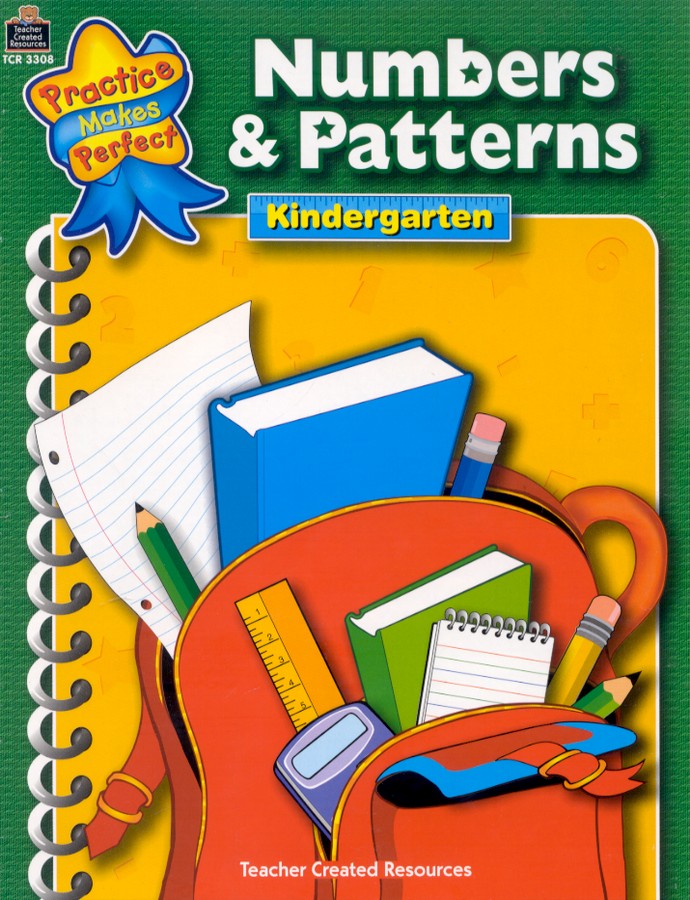
When we needed more ideas for our math play, we turned to some workbooks by Evan-Moor or Teacher Created Materials.
Both are frugal and done by well respected publishers. Here are some of our favorites:
Numbers and Patterns - Kindergarten
Both are frugal and done by well respected publishers. Here are some of our favorites:
Numbers and Patterns - Kindergarten
Lots of great ideas for math play here. Click the title to read my review of this resource.
Shapes and Beginning Fractions
Shapes and Beginning Fractions
This little resource gave us more ideas for our math play. We usually used our manipulatives along with the book, so that my daughter could do the early math problems hands-on.
We would take one page at a time, encouraging my daughter to solve the problems by using her manipulatives.
Handling the manipulatives and working out the early math problems in the book, really makes early math come alive! One evening we even made pizza night into a lesson on fractions.
We would take one page at a time, encouraging my daughter to solve the problems by using her manipulatives.
Handling the manipulatives and working out the early math problems in the book, really makes early math come alive! One evening we even made pizza night into a lesson on fractions.
Who gets to eat the last piece, 1/4th?
Evan-Moor Educational Publishers has lots more preschool, kindergarten and early elementary workbooks here.

Has your little one begun to explore early math yet?
Whatever way that you decide to introduce math to your little ones, enjoy it. I sure did.
Whatever way that you decide to introduce math to your little ones, enjoy it. I sure did.
For more encouragement for homeschooling your young ones, click here - 6 Tips to Homeschool your Preschool or Kindergarten Child] from my friend, Terrie.
Thanks for stopping by BJ's Homeschool,
Betsy
Betsy is a former O.T, preschool teacher, homeschooling mom and published author of children's stories. She blogs at BJ's Homeschool about the early years, high school, college, and is the author of "Homeschooling High School with College in Mind". She offers free homeschool help through messages at BJ's Consulting.


